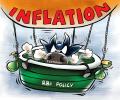
Analysts say RBI will cut rates because the liquidity crunch that began this time last year is still hurting the economy and also with an eye on the August industrial production numbers, which showed a contraction by 1.1 per cent -- the steepest in seven long years.

RBI also retained its GDP growth forecast at 7.6 per cent

Equity benchmark Nifty scaled the psychological milestone of 21,000 in afternoon trade on Friday, and the Sensex touched its all-time intraday high of 69,888.33 after the central bank's decision to keep policy rates unchanged in line with market expectations. The 50-share benchmark index opened on a bullish note, after taking a breather on Thursday, and rose to 21,006.10. As many as 25 stocks were trading in the green, and 24 stocks defied the broader market and were trading in the negative territory.

India's services sector activity eased in August but growth rates for new orders remain elevated, as services firms indicated the sharpest upturn in new export business which acted as a catalyst for firms to expand their workforces as well as output, a monthly survey said on Tuesday. Despite falling from 62.3 in July to 60.1 in August, the seasonally adjusted S&P Global India Services PMI Business Activity Index indicated one of the strongest increases in output seen since mid-2010. For the 25th straight month, the headline figure was above the neutral 50 threshold.

The Reserve Bank's rate-setting panel will start its 3-day deliberations on Wednesday amid expectations of yet another rate hike of 50 basis points to check high inflation, in line with similar actions taken by other major central banks, including the US Fed. Based on the recommendations of the Monetary Policy Committee (MPC), the RBI had effected 50 basis points increase in repo rate each in June and August after raising the short-term lending rate by 40 basis points in an off-cycle decision in May. The MPC, headed by RBI Governor Shaktikanta Das, is scheduled to meet during September 28-30.

Firms seem to have adopted a wait-and-see approach on their plans until public policies become clearer upon the formation of a government.

Rajan said that even though inflation has breached the 6 per cent mark as against the RBI target of getting it down to 5 per cent by March 2017, the price rise scenario will ebb in future
Tuesday's policy announcement had a regulatory and development component.

The seasonally adjusted Nikkei India Services Business Activity Index fell to 50.2 in May, from 51.0 in April, pointing to the slowest growth rate in the current 12-month stretch of expansion.

'Whether I am optimistic or pessimistic is not the issue; I am just going by the evidence available.' 'The Indian economy and financial sector are now well-placed and very resilient in dealing with any kind of spillover coming from the external world.'

The man widely expected to be India's next central bank chief favours clipping the autocratic power of the role and giving more say to a monetary policy committee.
There is a near consensus that at least a 25 basis points cut, if not 50, can be expected in the June policy.

RBI unsure whether to cut rates or not in its next monetary policy.

India is likely to grow by 7.5 per cent in the first quarter of the current financial year, driven by rising aggregate demand and non-food spending in the rural economy, according to an article in the RBI's May Bulletin released on Tuesday. The Indian economy has demonstrated marked resilience in the face of geopolitical headwinds impacting the supply chain, said an article on the state of the economy published in the May Bulletin.
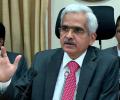
Das favoured shifting the stance of monetary policy from neutral to accommodative to send a clear signal, indicating that more measures could be taken in the near future to boost growth.

Heading to the third year, will Urjit Patel be busy firefighting a currency crisis? Almost no governor of the RBI managed to evade it and Patel perhaps knows it.
The imported inflation component is also expected to ebb on lower oil prices and softer US dollar, it said.

Given the various risks to growth, one could argue for rate cuts to be deeper than the 5 per cent terminal repo rate that we are projecting at this stage, says Kaushik Das.

Reserve Bank of India Governor Urjit Patel on Saturday exhorted banks to reduce their lending rates to push credit demand in laggard segments, saying banks have benefited from influx of low-cost deposits and its previous repo rate cuts.

The Governor said the MPC had voted to maintain its accommodative stance, implying more rate cuts in the future if the need arises.

India's prices are rising faster than many of its emerging market peers. The country's inflation print for May at 4.25 per cent is a marked reduction from the levels seen in May 2022 (7.04 per cent). However, even though the inflation rate remains within the Reserve Bank of India's medium-term target of 4 per cent, with a 2 per cent margin on either side, it continues to be higher than China, Russia, and Brazil.
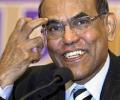
Monetary policy committee had recommended no change in the key rate.

As per the RBI Act, the central bank should have four deputy governors - two from within the ranks and one commercial banker and the fourth one an economist to head the monetary policy department.

The Reserve Bank on Wednesday retained the GDP growth forecast at 9.5 per cent for the current fiscal but cautioned that the economic recovery is not yet strong enough to be self-sustaining and durable.

Both the indices closed at five-month highs, led by financial services, IT and metal stocks, amid persistent foreign fund inflows.

The wholesale price-based inflation rose for the second consecutive month in February to 4.17 per cent, as food, fuel and power prices spiked. The WPI inflation was 2.03 per cent in January and 2.26 per cent in February last year. After witnessing months of softening of prices, the food articles in February saw 1.36 per cent inflation. In January it was (-) 2.80 per cent.

RBI wants periodic revision of the pensions for its retired employees.
However, the RBI is still not in a mood to issue an OMO calendar, which was the expectation in some sections of the market.
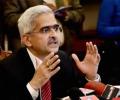
Many analysts over the past week have said the RBI has legroom to cut rates to the tune of 65 bps by June and some like Barclays and BofA have also spoken about the likelihood of an inter-meeting cut.

RBI said inflation in the second half of the current fiscal is projected at 2.7-3.2%. It retained its GDP forecast for the current fiscal at 7.4%

Manufacturing activities in India fell to a five-month low in September as new orders rose at a softer pace, which tempered production growth, a monthly survey said on Tuesday. The seasonally adjusted S&P Global India Manufacturing Purchasing Managers' Index (PMI) fell to 57.5 in September, down from 58.6 in August -- the lowest in five months. The September PMI data pointed to an improvement in overall operating conditions for the 27th straight month.
The RBI's surprise rate hike may have been prompted by its inability to convince the government to cut excise duty on petrol and diesel and take other supply-side measures to tame runaway inflation, sources aware of the central bank's thinking said on Thursday. There has been a record Rs 10 a litre increase in petrol and diesel prices in a matter of 16 days beginning March 22, which has further fuelled the already high commodity prices. The RBI, which is mandated to ensure inflation is under 6 per cent, acted with a 0.40 per cent increase in repo rate to check prices before they went completely out of hand.
Chetan Ghate, Pami Dua and Ravindra Dholakia have been appointed for 4 years

Jaitley said if interest rates were lowered, the economy could grow faster than 7-7.5 per cent.
Heightened geopolitical uncertainties will lead the Reserve Bank's rate-setting panel to opt for a status quo at the next week's meeting, Axis Bank's chief economist Saugata Bhattacharya said on Monday. Bhattacharya said he had earlier expected a tightening action at the policy meet scheduled for April 6-8 but the increased uncertainties on the geopolitical front due to the Russian invasion of Ukraine and its impact on commodity prices makes him now think that RBI will defer such an action. He said the central bank's Monetary Policy Committee (MPC) may hike rates in the second half of FY23 by up to 0.50 per cent.
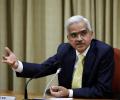
Reserve Bank Governor Shaktikanta Das on Wednesday said the country is at the doorstep of economic revival on the back of accommodative monetary and fiscal policies being pursued by the central bank and the government.

Rajan's exit will neither affect the RBI's de facto independence nor its working.

Retail inflation fell to a 15-month low of 5.66 per cent in March, mainly due to a decline in food prices, government data showed on Wednesday. The inflation figure in March is within the RBI's comfort zone as it is below 6 per cent. The retail inflation based on Consumer Price Index (CPI) was 6.44 per cent in February 2023 and 6.95 per cent in the year-ago period.

India's economic growth will be above 6 per cent in the current fiscal as the country has managed to strengthen its macroeconomic stability and performance even in a period of large global shocks, RBI Monetary Policy Committee (MPC) Member Ashima Goyal said on Monday. Goyal further said that a global slowdown reducing India's export growth, geopolitics fueling oil and food prices, and erratic weather are some of the continuing risks that the country faces. "India has managed to strengthen its macroeconomic stability and performance even in a period of large global shocks.
Lower inflation, FCNR(B) outflows likely to influence central bank decision
